The Forbidden City (Forbidden Palace, 紫禁城) lies in the center of the city. It is the hub around which the city has grown. It's walls are considered the first ring of the city, followed by subsequent rings. The rings beyond the palace have become major roads that encircle the city. I live adjacent to the 2nd ring road, and thus, not very far from the palace (10min bus ride). The 2nd ring road was once a wall itself, but it was demolished sometime during the mao-era to create a road system for the booming population. A few sections remain, like around Hepingmen.
So, why is it forbidden? Well, it's not, at least not anymore. The Forbidden City was opened to ordinary citizens in 1912. That year marks the end of the last dynasty, the Qing dynasty, and the year during which China abandoned monarchy and became a republic. Before then, the Forbidden City was the home of the emperor, the imperial throne of the country; a place of imperial business and personal affairs. The inner city was restricted to the emperor, his concubines, and over 1000 of his serving eunuchs. More on wikipedia.
Overall, I found the experience pretty mild. There was one massive tick against it to begin with: many of the major temples are being restored in time for the tourist surge the Olympics will no doubt cause. Also, it was a bit expensive for a something in China, 60Y entry fee, 15Y to see the extra part at Tian'anmen, and the snack prices were pretty exorbitant. I understand that this all translates to under $15, but I no longer convert to Canadian because it's too easy to spend too much that way.
The nicest part in my opinion is the imperial garden in the North-most section. Also, Jingshan park, directly North of the palace, was a nice highlight. The park was created with the soil that was excavated in order to create the moat that surrounds the entire complex, and the artificial lakes to the West of the palace grounds, Nanhai. At the top of the hill is a nice little temple with a good view of the city. I waited for a clear day to check out the temple and Jingshan park. Entry to the park was a lofty 2Y ($0.30)... I sometimes wonder why they charge in the first place. After a brisk upward walk, there's an excellent view of the city.
Beijing has a very different layout from most western cities. What one would think is the downtown, the central area of the city, is quite flat and full of hutongs (old-style Beijing neighbourhoods). The 2nd ring road is where everything grows. So, the skyscrapers form a ring around the city-centre. Anyway, the view was quite nice, it's the highest point in the city-centre, so you can see the ring growing all around.
The front of Tian'anmen (gate of Heavenly Peace). This is the south entrance to the Forbidden City.
Of course, there's still a huge portrait of Mao adorning the Gate of Heavenly Peace. Ironic? A bit...
The view while entering through Tian'anmen.
For an extra 15Y, I went up into the Tian'anmen building. It was well adorned. This is where the emperor used to receive criminals and give addresses.
The sign says "No photography please"... so I snuck this one.
The view from Tian'anmen, facing South, overlooking Tian'anmen Square.
You may have noticed this building on the right hand side of the above photo. It's the new national theatre, currently under construction. The locals call it the "big egg".
A zoom from on top of Tian'anmen. You can see the Monument to the People, in front of Mao's Mausoleum.
At the rear of Tian'anmen, looking North into the Forbidden City complex. The middle stucture is the next gate.
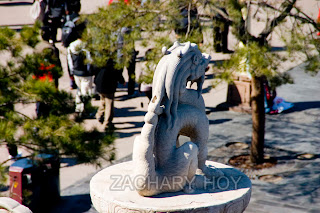
Cool statue I saw from the courtyard.
And the same statue from the rear of Tian'anmen. A bridge within the complex. These guys were dressed up on the 2nd gate, everyone was looking at them, surprised. Perhaps it's not every day that they dress up in imporial garb. Some of the squares inside had a nice, rustic feel. It was cool to think of all the officials and historical figures who may have helped to wear down these stones by just walking on them.
A cool, original cauldron. Safety number one! This was one of China's slogans for the Olympics, they're quite clearly full of it.
There was grass growing on these yellow-tiled roofs.
A cool relief carving. (damn railing shadow)
This is sort of the highlight of the entire complex, and as you can see, the main temple is fully covered with scaffolding. It was quite a let-down.
This is the largest single stone carving in the world. The stone was transported to the palace by pouring water to make an ice-path in the dead of winter, and then gliding it along. It took 10,000 men 3 months to move.
This was a particularly popular venue. This was the empresses quarters. Apparently, one famous empress hanged herself from a beam in this room sometime in the 16th century.
The entrance to the imperial gardens.
This is the view from the North exit of the palace. In the distance is Jingshan, my next destination.
Looking North from the peak of Jingshan. A cool contrast of old vs. new.
This is the Northwest guard station of the Forbidden City, as seen from Jingshan.
The EGG, from Jingshan.
A look over the Forbidden City.
The other people looking with me. The view N and NE from Jingshan.
I had heard from a few people that there was a firing range somewhere near Beijing at which you can fire all sorts of cool guns, including anti-aircraft, anti-tank, rocket launchers and the like. Well, the rumours were partly true, though not quite as exotic as I initially believed. Jason, an Australian kungfu master (!), was particulary interested in firing an AK-47, and after hearing him talk about it for a while (0.5 seconds) I got the bug, if only just to be able to say I've fired an automatic weapon.
Finding information about the firing range was another thing. Neither of the 2 guide books I brought had anything about it, and an internet search proved quite nearly futile. Luckily, Jason had lunch with a friend who knew all about it, not only where it was, but also the most economical way to get there, and he wrote the address in english and chinese, in case the cabbie's Beijinghua (Beijing accent) was too far gone to understand my perfect mandarin. haha.
Anyway, we set out early on the morning of February 19th. I met him and a student of his, David, at Dongzhimen subway station. At 8am. It was a bit tough for me to get up at 7ish, especially after having come home at 3ish, but my excitement drove me forward.
We went to the Deshengmen bus station, near Jishuitan subway station, which, conveniently, is closed now for construction. This meant we had to walk from the neighbouring subway station. The walk turned out to be quite pleasant, and gave a good view of the Deshengmen bus station. Normally, a view of a bus station would not be something considered pleasant, but this one is particularly interesting, since Deshengmen is an old gulou (meaning drum tower). It was built in 1440, and was a very important gate along the inner-city 2nd ring wall (now gone), opening up to paths leading to the a historically important section of the great wall (badaling pass). It was a nice surprise.
A river near Jishuitan
This guy had the unfortunate job of cleaning it from the side. The lighting in this picture doesn't really give a good impression of how futile it seemed.
It's the year of the pig!
Yeah... something about a fish from those waters doesn't seem appealing to me.
I had to sidle close enough to take this picture.
Deshengmen watchtower
The bus ride was 45min long each way, and the return ticket cost 12Y (about $2CAD). Bus-rides here are cheap. The bus we took, the 919, also goes to the badaling portion of the great wall, and the city we were destined for, Nankou, is on the way. We were sitting at the very back of the bus, which was packed to capacity (or beyond), and when we arrived in Nankou we had to snake our way to the front, through all the locals going to the great wall. This deboarding took a good 5min. And when we got to the front, the ticket-lady wouldn't let us get off, taking us for dumb foreigners who thought we were already at the wall. Jason and David, in front of me, seemed complacent, and when I determined what the hold up was, I let out my american-side; I yelled to let us off the damn bus. Two years of studying paid off a bit right there.
We got ripped on the taxi-ride. We weren't sure exactly how far outside of Nankou it was, I had read somewhere that it was 6km west but really didn't trust the source too much. A 5min taxi ride there cost us 20Y ($3), 50% more than the 1.5hr return bus ride. I wasn't so foolish on the way back to Nankou, which we got back to for 5Y. You actually have to bargain down EVERYTHING here, and the moment you let your guard down, BOOM, you've been ripped. There was a "Firing Range Registration" at the main gate, but we didn't have to register, or even give anybody our names the entire time. The range was here.
My first impression of the range was pure awe. They have a room in which they display something like a hundred different guns, modern, historical, handguns, sniper rifles, semis and automatics. A woman asks you to choose which guns you want to fire and how many clips. I learned soon enough that not all on display were available, that could choose from about a third of them... still plenty though. As well, we couldn't choose the rocket launcher or anti-aircraft gun, but I imagine if we could they'd have been too expensive anyway. There was an anti-tank gun set up somewhere, but the price began at 1000Y for 10rounds ($150CAD). They charge by the bullet, and based on chinese standards, it was quite expensive. The price of a round ranged from 8-12Y each, and you have to get a whole clip (I guess that's obvious). Since we were going mostly for the experience, and didn't wield particularly fat wallets, we shared a clip for each of the 3 guns we chose: the AK-47 (240Y for 30rounds), a 5.8mm american sniper rifle (120Y for 10 rounds), and a 9mm chinese military handgun (180 for 15 rounds). Total cost for firing three clips in three guns, 540Y ($75CAD), split three ways. $25 got me 20 bullets.
Unfortunately, they didn't let me bring my cameras into the firing zone. It sucks, I know. We desperately wanted pictures of ourselves wielding AK's in Rambo fashion (or war-torn-Africa fashion). However, I'll do my best to describe it. First of all, it was a beautiful and clear day, very unusual for the Beijing area. The mountains are very near, and you could not only see them well, but you could see many portions of the great wall (not the badaling section, I'm not entirely sure which section it was). If we wanted to, we could've fired at it.
The firing range is partly-indoors, with sliding doors leading to the firing groove (okay, so I don't know all the technical terms for a firing range). The firing groove is open in the front, but covered overtop. The targets are about 15m away, and behind them are large mounds of sand, and behind those, a few km away, the mountains and the wall. When it was our turn to shoot, we pass through the sliding doors, put on ear-muffs (but no eye protection), and they then sit you down on the table. I was manhandled into the right position, probably the most I've been pushed around in China yet. The gun, which was the sniper rifle first, is ready and on the table, with the end of the muzzle resting on a support-type thing. There were about 7 guys (and a woman) standing around watching me fire. If someone wanted to turn around and go buck wild on everybody, they probably wouldn't get very far with 8 ppl so close-by. The targets were brought in after each person's firing. The sniper rifle was difficult to aim, and I actually had better aim with the AK despite the lack of 10x zoom. There was barely any kickback with the sniper rifle, and the AK was quite manageable. It's a semi-automatic, and you just know I had to hold down the trigger to let off a few in a row. This probably negatively impacted my score, but I didn't care. The handgun was fired in a different portion of the range, set up for standing-fire instead of sitting. For the handgun, the target was closer, and I did much more poorly. Those western's are full of crap.
Prebattle
What a tease
We fired the top-most sniper rifle, 5.8mm.
The AK-47 is second down from the top.
The handgun we fired is on the right-most column, middle row.
Another tease, it wasn't even loaded.
After our trigger-happy morning, we returned to Beijing. Jason, who was bound to return to Australia in a few days, had been trying to see Mao's mausoleum for a couple of weeks now. Mao Zedong (or old-style translation, Tsetung) died of Parkinson's on Sept.9, 1976. At the time of his death, a hasty decision led to his body being pumped full of formaldehyde in order to be preserved. Funny thing is that too much liquid was used, and his face swelled up and became distorted. Fortunately, when the liquid was drained his face returned to its original shape. Now, his body rests in a mausoleum on the south end of Tian'anmen square, and is open to the public at very strange hours. Three times Jason had gone to see it, and each time it was closed, despite him being present during the hours posted outside of the mausoleum. Nothing in China is convenient, and predictably the 4th time was no charm. A brief chat with the military-outfit at the gate didn't help me to understand exactly why it was closed, but to expect explanations here is near-treason.
Not sure what this building is, but it's pretty grande.
By this point it was 2:30, and we had become hungry. South of Tian'anmen is an old gate area called Qianmen (rear gate). Next to it, running E-W, is an old hutong (literally translates to alley or laneway). Hutong's are spoken of much here. In the not-too-distant past, Beijing used to be made up entirely of hutongs, narrow roads that wound about haphazardly. Most of the old hutongs in Beijing are being bulldozed to make way for modern development, and the Beijing of today has mostly wide and cardinal roads (NS, EW, much like Toronto). The Qianmen hutongs are being kept though, supposedly, since they are considered a protected cultural location.
Qianmen on the right, old empirial theatre on left, as seen from here.
Jason. Looks like a nice guy... until he uses some ancient shaolin dragon kungfu technique that splits you in two.
The hutong was relatively wide, and full of restaurants. The odd thing about the restaurants though was that most had signs with a character I couldn't quite remember, some type of meat I didn't recognize immediately. I'd studied it at some point, but had since forgotten. It wasn't until I asked a local how to pronounce it did I realize that they were all offering meals using dog meat. I wasn't shocked because it was dog. I'll say this very clearly, we kill many intelligent animals for their meat, I don't see why dogs should be any exception. I was shocked because dog meat is not typically found in Beijing, it's much more common in NE and South China. Although I was very tempted to try a dog meal, we ended up at a little dumpling restaurant. The three of us ate dumplings, gongbao (kungpow) chicken, and rice, as well as drank a few beers and some green tea, all for 33Y ($5CAD). Mmmm.
The hutong houses use these charcoal bricks to cook their food. Spent ones become beige.
The first character to the right of the dish is 'dog'. I didn't think the meal looked like dog though, since the bones are kind of small. I guess they use small dogs.
View of the hutong from near where we ate. Of course, firecrackers being lit off.




 The view N and NE from Jingshan.
 The view N and NE from Jingshan.
 The view E and SE from Jingshan.


