Tonight, as I was casually watching a Chinese tv program whilst simultaneously surfing, playing a game, and reading updates about the India situation, I caught glimpse of something that I really never thought I'd ever see: a 70-year old Chinese lady performing hiphop dance. There was an entire special about her, relating her experiences on tv and different performances, the way her daughter felt about it (summary: shame gave way to acceptance). But I had to see it to believe it. Thought I'd share this with you. If you know of any equivalents in N.America, please let me know. I'm not sure how I'll console myself if I find out hiphop jumped about two generations in age and penetrated a hundred generations of Chinese culture all in one fell swoop.
Thursday, November 27, 2008

Wednesday, October 15, 2008
I'm living next to a (potential) bunker - updated
To the East of my apartment is a wonderful and rare thing in Beijing: an empty field. It's peaceful, serene and even has birds chirping in the morning. And since I face East I'm shielded from the noise of the massive hyper-busy third-ring road about 300m to the West. But that's all about to change, I think they're building a bunker in the field.

Looking East, Pingguo Shequ apartment complex, translates to "Apple Community"

 An exposure shot taken at night. looking NE

I always thought it was a bit strange that the entrance to the field has a "Military Restricted Zone" sign. I wasn't sure what it had to do with the military. I began to notice a lot of night activity in the field. Trucks coming to make deliveries at 4am, waking me up and stirring strong suspicions of conspiracy. Was there an underground nuclear test facility? Were they testing some strange hybrid plant that would be used to reduce smog? Why did a pair of two stray dogs live in the field?

About a week ago, the big machines came in. There are now three or four excavators, and a pile of thick-gauge steel cable spools. They've begun excavating minor portions of the field (dismissing my hybrid plant theory), but continue to work at night (supporting my secret underground facilities theory).
The mysterious spools of steel cable, under wraps

I know it's easy to dismiss conspiracy theories. I mean, why would they do it all in plain-sight of my window? But the nighttime excursions thoroughly perplex me. I suppose it's all half-secret, half-open. After all, the buildings on the East of the field also have full view of the field, as well as all the apartments above me for 26 stories.
I asked the guy who runs a little convenience store in the lobby of my building, and he told me they're constructing military buildings. I'm going to try to take some exposure shots at night when they're doing weird 4am digging.

The old view of the new BTV (Beijing Television) tower. Hopefully the view won't be blocked.

Looking East, Pingguo Shequ apartment complex, translates to "Apple Community"

A peaceful and tranquil morning as seen from my window.
 An exposure shot taken at night. looking NE
I always thought it was a bit strange that the entrance to the field has a "Military Restricted Zone" sign. I wasn't sure what it had to do with the military. I began to notice a lot of night activity in the field. Trucks coming to make deliveries at 4am, waking me up and stirring strong suspicions of conspiracy. Was there an underground nuclear test facility? Were they testing some strange hybrid plant that would be used to reduce smog? Why did a pair of two stray dogs live in the field?
Chinese for "Military Restricted Zone"

About a week ago, the big machines came in. There are now three or four excavators, and a pile of thick-gauge steel cable spools. They've begun excavating minor portions of the field (dismissing my hybrid plant theory), but continue to work at night (supporting my secret underground facilities theory).
The mysterious spools of steel cable, under wraps

I know it's easy to dismiss conspiracy theories. I mean, why would they do it all in plain-sight of my window? But the nighttime excursions thoroughly perplex me. I suppose it's all half-secret, half-open. After all, the buildings on the East of the field also have full view of the field, as well as all the apartments above me for 26 stories.
I asked the guy who runs a little convenience store in the lobby of my building, and he told me they're constructing military buildings. I'm going to try to take some exposure shots at night when they're doing weird 4am digging.
My new view, which will be changing daily. I'll try to take regular shots and make a montage.

UPDATED PHOTOS - OCT 16th to 29th
DAY 2

DAY 4

DAY 6

DAY 9

DAY 9 later
 DAY 13
 DAY 14
 DAY 2-14 composite
 The tunnel-drilling crane just outside my window

DAY 2

DAY 4

DAY 6

DAY 9

DAY 9 later
 DAY 13
 DAY 14
 DAY 2-14 composite
 The tunnel-drilling crane just outside my window
Thursday, September 18, 2008
A Brief Stint in Inner Mongolia
Mid-Autumn festival is usually celebrated by eating mooncakes with your family. Since my family is not here, and I despise mooncakes, I decided to do my own thing. Along with my friend Byron, I went to Inner Mongolia for a three-day minivisit.
Why Inner Mongolia you may ask? Well, our criteria was to go somewhere cheap-ish, within a quarter-day or so train ride from Beijing. This meant pulling up a map, and drawing a general finger-circle, and discussing the cities that lay within it. At the time, we were definitely under the influence, and Baotou, the largest city in Inner Mongolia province, began to sound attractive. Probably because we knew nothing about it.
Here's where I repeat some of the information I found on Wikipedia about Inner Mongolia. I only just now looked this up; we didn't look up anything before we left. Inner Mongolia is huge, covering about 12% of the land area of China (which is 9.6M km²). It's population is 24million, more than 2/3 that of Canada, yet considered somewhat measly in China.
Downtown Baotou, shopping district

And here's where I add some of the insight I've gained about Inner Mongolia. The entire province is generally considered to be a bit of a measly province, the remnants of a two-or-so millennia-long battle between Chinese, Mongolians, and more than a handful of minority tribes, of little interest to the average Beijing that I've spoken to about the area. The problem is that its rich history isn't marked by the staple establishments Chinese come to expect: temples, hero-shrines, artificial lakes, special regional animals. But it will become more popular in years to come, since the economy in the region is expanding at a rate of around 20% per year, twice the rate as that of the national economy. This is coming largely from newly exploited mineral reserves and a well-sustained agricultural community.
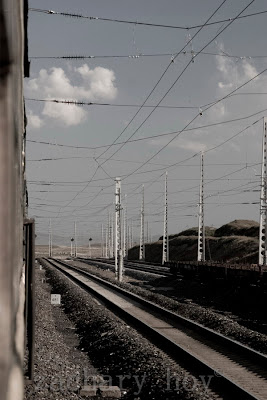
Since we didn't do any research before we left, we didn't know that there are no fast-trains heading there, so the train ride takes about 14hrs. Luckily we'd been up most of the previous night and managed to sleep through a large portion of the ride (Byron sleeping much more than me, as was also the case on the return trip as well).
What's to be found there? Well, we didn't find a whole lot, so we had to make do. Baotou is the largest city in Inner Mongolia, with over 2million people. And though this is puny in Chinese standards, it's not a village. The night-life however made this distinction difficult to make. Our first night there we arrived at 11pm, had something to eat, checked into our hotel, and after many inquiries about where the best club in town is (and a taxi driver taking us to a cruddy KTV), we made it to the club called "89." By this time is was 12:30ish. And the club was emptying out. It was quite upsetting. During this period we managed to meet our 2nd of many crazies we were to encounter during our stay here. The first encounter was at the restaurant we dined in; after having invited us to his table we realized his friend was ashamed of his drunkenness, which became clearer with every second, and eventually led to extremely vague comments about us all being men, and so needing to spend time together, in slurred local Chinese. The 2nd crazy was in the form of a 25yr-ish Chinese guy whose accent was too strong to understand so he reverted to hand-language which looked suspiciously like a squirrel unendingly opening a walnut, minus a walnut. He was the nut. We got away from him by feigning to go the washroom and fast-walking out. This is where we met some pretty cool guys who we hung out with on each subsequent night. Where? 89 of course. There's only one club in the city. And we learned that it's happening at 9ish, and dies around 12, so we adjusted.
Since we were super-disorganized, we didn't do heaps during the daytime. On day one, I wanted to see a Buddhist temple. Baotou has two, one very large and famous one about 45km out of town, and one within the city limits. I opted for the closer one, thinking it would be relatively equivalent. That was indeed a sore decision. We were the only people visiting it. And old female monk had to rouse the 16yo male monk (!) to open this for us to see. Since it was only Byron and I touring, I couldn't even sneak in a single indoor picture.
The front of the main temple

The exact location of where I took the above picture.


 Locals washing carrots in a stream that seemed to be to be unfit for washing veggies. But maybe that's just me.




Why Inner Mongolia you may ask? Well, our criteria was to go somewhere cheap-ish, within a quarter-day or so train ride from Beijing. This meant pulling up a map, and drawing a general finger-circle, and discussing the cities that lay within it. At the time, we were definitely under the influence, and Baotou, the largest city in Inner Mongolia province, began to sound attractive. Probably because we knew nothing about it.
Here's where I repeat some of the information I found on Wikipedia about Inner Mongolia. I only just now looked this up; we didn't look up anything before we left. Inner Mongolia is huge, covering about 12% of the land area of China (which is 9.6M km²). It's population is 24million, more than 2/3 that of Canada, yet considered somewhat measly in China.
Downtown Baotou, shopping district

And here's where I add some of the insight I've gained about Inner Mongolia. The entire province is generally considered to be a bit of a measly province, the remnants of a two-or-so millennia-long battle between Chinese, Mongolians, and more than a handful of minority tribes, of little interest to the average Beijing that I've spoken to about the area. The problem is that its rich history isn't marked by the staple establishments Chinese come to expect: temples, hero-shrines, artificial lakes, special regional animals. But it will become more popular in years to come, since the economy in the region is expanding at a rate of around 20% per year, twice the rate as that of the national economy. This is coming largely from newly exploited mineral reserves and a well-sustained agricultural community.
Since we didn't do any research before we left, we didn't know that there are no fast-trains heading there, so the train ride takes about 14hrs. Luckily we'd been up most of the previous night and managed to sleep through a large portion of the ride (Byron sleeping much more than me, as was also the case on the return trip as well).
What's to be found there? Well, we didn't find a whole lot, so we had to make do. Baotou is the largest city in Inner Mongolia, with over 2million people. And though this is puny in Chinese standards, it's not a village. The night-life however made this distinction difficult to make. Our first night there we arrived at 11pm, had something to eat, checked into our hotel, and after many inquiries about where the best club in town is (and a taxi driver taking us to a cruddy KTV), we made it to the club called "89." By this time is was 12:30ish. And the club was emptying out. It was quite upsetting. During this period we managed to meet our 2nd of many crazies we were to encounter during our stay here. The first encounter was at the restaurant we dined in; after having invited us to his table we realized his friend was ashamed of his drunkenness, which became clearer with every second, and eventually led to extremely vague comments about us all being men, and so needing to spend time together, in slurred local Chinese. The 2nd crazy was in the form of a 25yr-ish Chinese guy whose accent was too strong to understand so he reverted to hand-language which looked suspiciously like a squirrel unendingly opening a walnut, minus a walnut. He was the nut. We got away from him by feigning to go the washroom and fast-walking out. This is where we met some pretty cool guys who we hung out with on each subsequent night. Where? 89 of course. There's only one club in the city. And we learned that it's happening at 9ish, and dies around 12, so we adjusted.
Since we were super-disorganized, we didn't do heaps during the daytime. On day one, I wanted to see a Buddhist temple. Baotou has two, one very large and famous one about 45km out of town, and one within the city limits. I opted for the closer one, thinking it would be relatively equivalent. That was indeed a sore decision. We were the only people visiting it. And old female monk had to rouse the 16yo male monk (!) to open this for us to see. Since it was only Byron and I touring, I couldn't even sneak in a single indoor picture.
The front of the main temple

The exact location of where I took the above picture.
Fo, the character for Buddhism


Mongolian script. Only about 15% of people in Inner Mongolia are of Mongolian descent, the bulk of the remainder are Han Chinese, so very few locals can read this script.


From there we saw a large statue on a mountain, and decided our next task would be to climb up to see it. This required refuelling. So after going back to the hotel, eating and buying supplies, we got in a taxi and said (take us to a mountain). It took surprisingly little explaining for him to understand we just wanted to ascend any mountain nearby to a road so that returning to normal life wouldn't be too difficult. He took us to a location with a cemetary at the base. At first I was enthralled to see a cemetary, since there are none in Beijing (so then where do people part with their loved ones? I'll let you know when I do). But it lost its thrill after we realized how sanitary and uninteresting it all was. Cemetaries should be creepy. This place was too clean to be creepy.


From there we tackled what at first appeared to be a simple ascent, and turned into quite a lug. The mountain there was being mined for something, though we weren't able to figure out quite what. It was a small operation, no equipment, just bags, shovels, wheelbarrows and dynamite. The result was the the gentle sloping portions had big gaps in them. But it didn't take away from the beauty.


That night turned into an intense 89'er, and we slept pretty late. Having no concrete plan for what to do, I went to an internet cafe to do some searching. A friend had told me that Inner Mongolia had sand dunes, and with a bit of effort I finally found what I was looking for: Whistling Sand Dunes. Apparently, when it is quite hot, the sand makes a whistling noise. The next step was finding out how to get there. Many travel services were offering 200/person, minimum 4 people. We were two. We eventually ended up taking a taxi there. The cool female driver waited for us (over 2hrs) and drove us back (total 2hrs commute) for 300yuan. Not bad. Apparently this day wasn't hot enough, as it was only 28degrees. I'm not sure it gets much hotter in Inner Mongolia, but it must, because the sands weren't whistling. That didn't upset me, as there was enough noise in the first place. It was quite touristy, and admittedly expensive for such a remote attraction, but well worth it. The view on the way in is the most breath-taking. As you get closer and more level with the dunes it becomes less grand. The park has a series of activity stations set up. Firstly, you take a cable car across a wide chasm. You can walk, but you only save 40yuan, and have to climb a very large dune on the other side. When we arrived to the other side, we were pleasantly surprised by the sand-booties they rent out for 10yuan. The colours were screaming loud, but they were extremely useful, and kept all sand out of my shoes. The stations include: horseriding, camel riding, sand sliding, dune buggy excursions, 4x4 riding, archery, "space-ball" (so stupid) and long-range jeep excursions. We got there quite late, and so had little time to enjoy much. But I'm sure we would've done more if the sandstorm hadn't swept in!


I don't know these two. They took a picture of me and my friend with their cell phone, so I took a picture of them. I didn't expect them to pose and for it to turn out so well.

Camel-rides. The storm killed this option for us.


Some great chinglish.


4x4'ing on the dunes, amazing fun.
 The storm moving in.


 The storm moving in.


A coal train emerging from a tunnel in the cliff-face and traveling through the sand storm.

After the wind, and just before the rain.

After the wind, and just before the rain, camels just chilling.


Finally captured a streak of lightning, really not easy.
Our last night was celebrated in the best club Baotou has to offer... again, 89! A sobering 14hr train ride back to Beijing awaited me. Byron slept for roughly 12 of those hours... me, about 2hrs. At least I got some nice pictures of Inner Mongolia farmland.

 Locals washing carrots in a stream that seemed to be to be unfit for washing veggies. But maybe that's just me.


Subscribe to:
Posts (Atom)
